

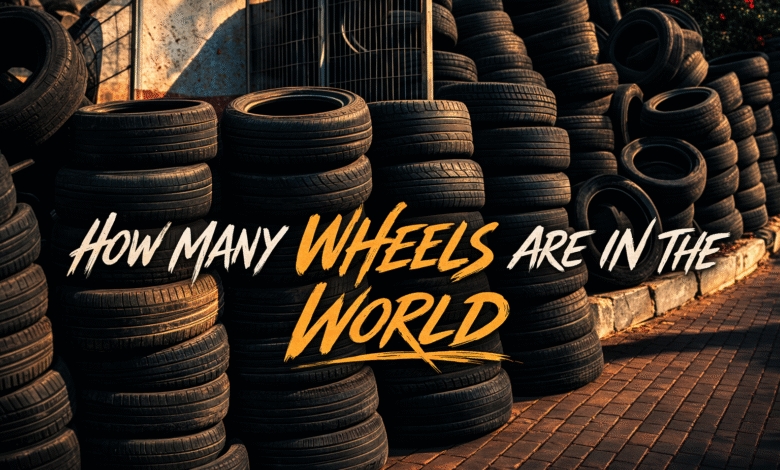
Have you ever stopped to think about how many wheels are in the world right now? It seems like a simple question, but the answer isn’t easy. From cars and bikes to toys and office chairs, wheels are everywhere around us. They move our lives, both literally and figuratively. Let’s explore this fascinating question and dig deeper into just how many wheels might exist on our planet today.
Why People Ask: How Many Wheels Are in the World?
The question “how many wheels are in the world” became popular online. People began debating wheels versus doors. The conversation spread quickly across social media. What started as a small question turned into a global curiosity.
Why such interest? Because wheels represent movement, connection, and innovation. They’re part of almost every object we use daily. Yet, most of us never stop to count them.
What Exactly Counts as a Wheel?
Before answering how many wheels are in the world, we must define what a wheel really is.
A wheel is a circular object that turns around an axle to move or carry things more easily. By that rule, wheels exist in many forms — not just in transport vehicles.
Here are some examples:
- Cars and trucks – each has 4 or more wheels.
- Bicycles and motorcycles – 2 wheels each.
- Airplanes – dozens of wheels on landing gears.
- Trains – hundreds of steel wheels per set of carriages.
- Toys – from LEGO pieces to small remote-control cars.
- Office and furniture wheels – chairs, suitcases, carts, and trolleys.
- Machines and gadgets – gears, conveyor rollers, factory equipment.
So, when we ask how many wheels exist globally, we must include all these forms.
Estimating the Number of Wheels Worldwide
There’s no official count of wheels in the world. But let’s make some smart estimates based on available data.
1. Cars and Other Motor Vehicles
As of 2026, there are about 1.5 billion cars in the world. Most cars have:
- 4 main wheels
- 1 spare wheel (in many models, not all)
If we assume 80% of cars carry a spare, we can calculate:
(1.5 billion×4)+(1.2 billion×1)=7.2 billion wheels(1.5 \text{ billion} \times 4) + (1.2 \text{ billion} \times 1) = 7.2 \text{ billion wheels}(1.5 billion×4)+(1.2 billion×1)=7.2 billion wheels
So cars alone may account for around 7 billion wheels.
Now add buses, vans, and trucks. These vehicles often have 6, 8, or more wheels. Estimating another 500 million such vehicles:
500 million×6=3 billion wheels500 \text{ million} \times 6 = 3 \text{ billion wheels}500 million×6=3 billion wheels
That brings our total close to 10 billion wheels from road vehicles alone.
2. Motorcycles and Bicycles
There are over 1.1 billion bicycles used worldwide. Each has 2 wheels:
1.1 billion×2=2.2 billion wheels1.1 \text{ billion} \times 2 = 2.2 \text{ billion wheels}1.1 billion×2=2.2 billion wheels
Motorcycles? About 250 million exist around the world. Each has 2 wheels too:
250 million×2=500 million wheels250 \text{ million} \times 2 = 500 \text{ million wheels}250 million×2=500 million wheels
Adding these gives 2.7 billion wheels from two-wheeled vehicles.
3. Aircrafts
Planes have many wheels depending on their model. A large passenger jet can have 10 to 18 wheels. A smaller private jet may have 3.
There are roughly 25,000 commercial aircraft and 23,000 private jets in service. Taking an average of 8 wheels per aircraft:
48,000×8=384,000 wheels48,000 \times 8 = 384,000 \text{ wheels}48,000×8=384,000 wheels
That’s about 0.00038 billion, small compared to cars, but still notable.
4. Trains
Trains are full of wheels! A standard train wagon has 8 wheels. Freight trains can have more.
The International Union of Railways estimates 1.3 million train cars globally:
1.3 million×8=10.4 million wheels1.3 \text{ million} \times 8 = 10.4 \text{ million wheels}1.3 million×8=10.4 million wheels
That’s roughly 0.01 billion wheels.
5. Office and Furniture Wheels
Think of all the rolling office chairs, luggage bags, carts, and strollers worldwide. These small items quietly add billions of wheels.
- Office chairs: Each usually has 5 wheels. If there are 1 billion office chairs globally: 1 billion×5=5 billion wheels1 \text{ billion} \times 5 = 5 \text{ billion wheels}1 billion×5=5 billion wheels
- Suitcases and trolleys: About 3 billion pieces of luggage exist worldwide, most with 2–4 wheels. Average of 3 wheels gives: 3 billion×3=9 billion wheels3 \text{ billion} \times 3 = 9 \text{ billion wheels}3 billion×3=9 billion wheels
That’s already 14 billion wheels from personal and office items alone.
6. Toys and Miniature Wheels
Now comes the big surprise — toys.
LEGO alone has produced more than 400 billion plastic tires since its creation. These are officially considered the world’s largest tire manufacturer — more than any car company.
If LEGO’s 400 billion is just one example, imagine adding toy cars, action figures, and strollers made by other brands.
A conservative guess gives us 500 billion toy wheels worldwide.
7. Factory and Machine Wheels
Factories use countless wheels — rollers, conveyor belts, gears, cogs, pulleys, and industrial machines. Each counts, technically. Though hard to measure, global industry may easily have:
- Around 50 billion wheels in use daily.
Adding It All Up
Let’s sum up our rough but realistic estimates:
| Category | Estimated Wheels (in billions) |
|---|---|
| Cars, buses, trucks | 10 |
| Bicycles and motorcycles | 2.7 |
| Aircraft | 0.0004 |
| Trains | 0.01 |
| Office chairs and luggage | 14 |
| Toys (LEGO and others) | 500 |
| Machinery and factories | 50 |
| Total (approximate) | ~576 billion wheels |
That’s right — there could be over 570 billion wheels in the world, possibly even more if we include hidden ones inside machines, pulleys, or consumer products.
Surprising Facts About Wheels
Here are some fun wheel-related facts might surprise you:
- Oldest wheel: The first known wheel dates back to around 3500 BCE, found in Mesopotamia.
- Wheels changed civilization: They helped humans travel, farm, and build new technologies.
- LEGO dominance: LEGO makes around 300 million wheels per year, beating every car company combined.
- Multiple wheels in one machine: Even a single printer or clock can contain dozens of tiny wheel mechanisms.
- Not all wheels are round: Some scientific prototypes use square or oval wheels for educational demonstrations.
The Wheels vs. Doors Debate
When the internet debated whether there were more wheels or doors in the world, people were shocked by the complexity.
Team Doors argued that every house, car, fridge, and cupboard has multiple doors.
Team Wheels countered that almost everything that moves — cars, toys, and machinery — uses wheels.
If we trust the estimates above, wheels might outnumber doors by hundreds of billions. LEGO and toy vehicles alone push the count sky-high.
Why Wheels Are So Important
It’s easy to overlook something as ordinary as a wheel, but they are one of humanity’s greatest inventions. Here’s why they matter so much:
- Transportation: Cars, bikes, and buses rely on wheels for mobility.
- Industry: Conveyor belts, machines, and production lines depend on wheel motion.
- Convenience: Rolling luggage, wheelchairs, and office chairs make daily life easier.
- Innovation: From robots to aircraft landing systems, the wheel keeps evolving.
Without wheels, global transportation and mechanical engineering would collapse.
How Wheels Impact Daily Life
Even if you’re sitting still, you are surrounded by wheels:
- The chair you sit on has wheels.
- Your drawer slides may roll on small wheel bearings.
- The fan motor works through rotating components like wheels.
- The grocery cart uses four wheels on every visit to the store.
- Even roller skates and skateboards have multiple wheels.
Everything that rolls, spins, or turns owes its function to the wheel design.
Fun Comparison: Wheels vs. Population
Let’s put this number in perspective. The current world population is around 8.1 billion people.
That means there may be over 70 wheels for every single person on Earth — incredible when you think about it!
Will the Number of Wheels Keep Increasing?
Absolutely. As technology advances and urbanization grows, we’ll see more:
- Electric vehicles and delivery robots.
- Factory automation with wheels and rollers.
- Smart luggage and personal devices that use micro wheels.
- Toy production continuing to rise annually.
Each of these adds millions — even billions — of new wheels to our world each year.
So, the question “how many wheels are in the world?” will keep changing, growing, and expanding.
How to Visualize the Scale
Let’s imagine it visually:
- 570 billion wheels could circle the Earth over 4,000 times if lined up edge-to-edge.
- Laid flat, they could easily cover more area than the Sahara Desert.
- The total weight of toy wheels alone could reach millions of tons.
Mind-blowing, right?
This shows how deeply the wheel shapes human civilization.
What This Tells Us About Human Progress
Counting wheels isn’t just a curious hobby — it reveals something powerful about human progress.
- The spread of technology mirrors the increase of wheels.
- Movement and trade depend on rotating systems.
- Innovation continues as new wheel forms appear in robotics and engineering.
From the first cart to electric scooters, the wheel remains humanity’s most practical idea.
The Hidden Wheels We Forget About
You might not even notice many wheels around you. Hidden wheels operate quietly in:
- Elevators (pulleys use wheel principles)
- Printers and copiers
- Vending machines
- Washing machines and dryers
- Skateboards and toys
- Factory belts and motor gears
If we count every single moving wheel-like part, the number could even exceed one trillion globally.
Summary: So, How Many Wheels Are in the World?
To recap, based on realistic assumptions and market data:
| Source | Estimated Wheels |
|---|---|
| Vehicles (cars, trucks, buses) | 10B |
| Motorcycles & bicycles | 2.7B |
| Airplanes & trains | 0.02B |
| Office chairs & luggage | 14B |
| Toys & miniatures | 500B |
| Machines, factories, hidden parts | 50B |
| Approximate Global Total | 570–600 billion wheels |
That’s a number so vast it’s nearly impossible to picture — yet it’s likely close to reality.
Final Thoughts
The next time someone asks you, “how many wheels are in the world?”, you can answer proudly:
There are probably between 570 and 600 billion wheels — maybe even more if we count every hidden one.
Wheels make the world go round, in every sense. From the cars we drive to the toys kids love, from the machines that build skyscrapers to the suitcases that roll through airports — wheels are the unsung heroes of human progress.
They connect us all. They never stop turning.
And maybe that’s the most amazing part of all.