


AR glasses have promised immersive, wearable cinema for years. The reality has been different — washed-out colors, flat contrast, and shadow detail that vanishes in dark scenes. Even the best wearable displays on the market have been limited to SDR and roughly 16.77 million colors.
That narrative shifted when RayNeo gave the Air 4 Pro its global debut at CES 2026 — billing it as the first HDR 10 Display AR Glasses. ZDNET’s editor-in-chief headlined his hands-on coverage with the claim it “can easily replace my living room TV.” Tom’s Guide called the visuals “absolutely stunning.” So is this justified?
Why HDR10 Changes the Game for Wearable Displays
Standard Dynamic Range has been the practical default for consumer AR glasses since the category began. SDR content typically uses 8-bit color depth, which means subtle gradients can look noticeably banded and dark scenes may lose fine detail. For a device meant to simulate a private cinema, that has been a persistent limitation.
HDR10 enables 10-bit color — over a billion hues — and supports wider brightness ranges, though actual results depend on hardware, source content, and environment. RayNeo’s Air 4 Pro is positioned as the first HDR 10 Display AR Glasses to bring this standard to wearable form. The latest AR Glasses generation suggests that claim holds weight.
What the Air 4 Pro Display Actually Delivers
The Air 4 Pro is built around a pair of SeeYa 0.6-inch micro-OLED panels at Full HD resolution. These panels are the foundation behind its billing as the first HDR 10 Display AR Glasses — but the supporting hardware matters just as much.
10-Bit Color and Over a Billion Hues
The jump from 8-bit to 10-bit color is the single biggest visual upgrade here. Where the previous Air 3s Pro offered roughly 16.77 million colors, the Air 4 Pro pushes past a billion. In practice, that means smoother gradients, more natural skin tones, and shadow detail that standard smart glasses simply cannot reproduce.
Brightness, Contrast, and PWM Dimming
Perceived brightness reaches 1,200 nits — enough to preserve HDR highlight detail without clipping. Micro-OLED pixel-level dimming keeps blacks deep in controlled lighting, making HDR10 visually meaningful rather than decorative. The TÜV SÜD-certified 3,840Hz PWM dimming also reduces flicker, especially relevant for anyone watching through the first HDR 10 Display AR Glasses during longer sessions.
The Vision 4000 Chip
Powering the pipeline is a customized Pixelworks Vision 4000 processor. It handles real-time SDR-to-HDR upscaling, so everyday streaming gets a visual boost — though RayNeo notes HDR10 and upscaling require compatible source devices and DisplayPort output. The chip also supports 2D-to-3D conversion, which Tom’s Guide noted was not demonstrated at CES.
Sound, Comfort, and Connectivity
A display only shines if the rest of the package keeps up. The Air 4 Pro pairs its first HDR 10 Display AR Glasses credentials with premium audio and a design light enough for extended wear — a combination few competitors at this price can match.
Four B&O-Tuned Speakers
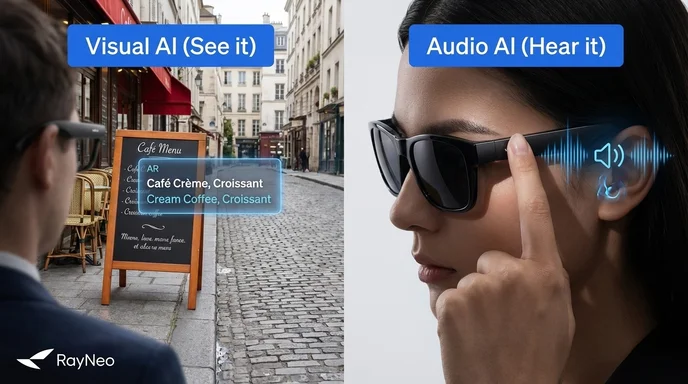
The Air 4 Pro retains the quad-speaker layout of the Air 3s Pro but adds Bang & Olufsen co-tuning and redesigned acoustic architecture. Optional SoundTube accessories, sold separately, further direct audio toward the ears while reducing leakage. Tom’s Guide reported “boosted bass and clear audio” during a CES hands-on demo.
76 Grams and Universal USB-C
At 76 grams, the Air 4 Pro is light enough for extended viewing without significant fatigue, according to multiple hands-on reports. RayNeo supports swappable prescription lenses up to -10.00 diopters, though custom lenses are ordered separately at additional cost. Connectivity runs through USB-C with display output, covering a wide range of devices:
- Smartphones — iPhone 15 through 17 series, Samsung Galaxy S-series, Pixel, OnePlus, and more
- Computers — MacBook, iPad Pro, Surface, and most USB-C laptops
- Gaming handhelds and consoles — Nintendo Switch 2, Steam Deck, and PS5 via adapter (per Tom’s Guide hands-on)
How the Air 4 Pro Stacks Up in 2026
No review is complete without context. The wearable display market in 2026 has several strong contenders, and the Air 4 Pro’s first HDR 10 Display AR Glasses advantage needs to be weighed against what competitors offer in terms of features, pricing, and overall value.
vs. Xreal One Pro
The Xreal One Pro offers Bose-tuned spatial audio and advanced spatial computing via its self-developed X1 chip — features the Air 4 Pro does not currently match. However, it has not advertised HDR10 support. Pricing varies by retailer, with listings ranging from $599 to $649.
For buyers who prioritize HDR display quality per dollar spent, the Air 4 Pro presents a compelling alternative with its first HDR 10 Display AR Glasses technology and premium B&O audio at a significantly lower price point than the Xreal flagship.
vs. Asus ROG Xreal R1
The ROG Xreal R1 also debuted at CES 2026, targeting gamers with a 240Hz refresh rate — double the Air 4 Pro’s 120Hz. It features Bose-tuned audio like its Xreal siblings, but has not advertised HDR10 support, and pricing remains unconfirmed. Gamers focused purely on frame rate may lean toward the R1.
Those prioritizing color accuracy, cinematic HDR viewing, and proven display performance will likely prefer RayNeo’s first HDR 10 Display AR Glasses approach, which trades peak refresh rate for meaningful and measurable gains in contrast, color depth, and overall visual fidelity.
Quick Comparison
| Feature | RayNeo Air 4 Pro | Xreal One Pro | ROG Xreal R1 |
|---|---|---|---|
| HDR10 | √ (first in category) | Not advertised | Not advertised |
| Refresh Rate | 120Hz | 120Hz | 240Hz |
| Audio | B&O (4 speakers) | Bose (spatial) | Bose-tuned |
| Weight | 76g | 87g | 91g |
| Price (MSRP) | $299 | $599–$649 | TBD |
Who Should Buy — and Who Should Wait
The Air 4 Pro is not for everyone. Understanding where it excels and where it falls short is key to deciding whether this first HDR 10 Display AR Glasses release matches your specific needs, usage habits, and expectations for a wearable cinema experience.
Best For
- Frequent travelers who want a 201-inch virtual-equivalent cinema without hauling a monitor — HDR10 plus B&O audio delivers a compelling private-viewing experience
- Console and handheld gamers on Switch 2, PS5, or Steam Deck who want richer colors and real contrast at 120Hz
- Upgraders who tried earlier smart glasses but were disappointed by flat, SDR-limited image quality
Consider Waiting If
- You are a competitive PC gamer who needs 240Hz — the 120Hz ceiling may not satisfy high-frame-rate demands
- You want standalone AR experiences without connecting an external device — the Air 4 Pro requires a USB-C source
- You already own the Air 3s Pro and are satisfied with its display — the HDR10 upgrade is meaningful but may not justify the cost for every user
The Verdict
RayNeo asked a bold question by marketing the Air 4 Pro as the first HDR 10 Display AR Glasses to perfect HDR on a wearable display. After examining the specs, the chip architecture, and consistent praise from ZDNET and Tom’s Guide, the answer is nuanced but encouraging.
“Perfect” may be premature — verified 3D performance is still pending, 120Hz trails the bleeding edge, and real-world black levels will vary with ambient light. But based on published specs and early press impressions, this is genuinely the closest any wearable display has come to delivering TV-grade HDR quality on your face.
At $299, the Air 4 Pro offers the strongest display-to-price ratio in this category heading into 2026. If you have been waiting for HDR to finally arrive on a wearable screen, RayNeo has made the strongest case yet that the technology is ready.
READ ALSO: How Artificial Intelligence Is Transforming Website Quality Assurance