

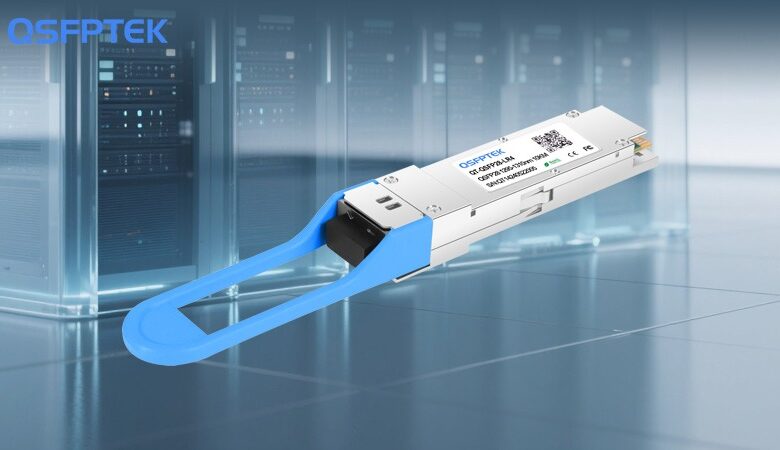
As 100G networking becomes increasingly common across data centers, enterprise campuses, and service provider networks, choosing the right optical module is no longer a trivial decision. While multiple 100G QSFP28 modules are available on the market, each designed for different transmission distances and deployment scenarios, selecting the wrong one can lead to unnecessary costs or performance limitations. Among these options, LR4 often appears as the go-to solution for medium-to-long reach connections, but many users are still unsure when it is truly needed.
The confusion usually comes from the overlap between different 100G solutions such as SR4, PSM4, and CWDM4. At first glance, they all deliver 100G bandwidth, yet their real-world applications differ significantly. Understanding where 100G QSFP28 modules fit into a 10km network scenario requires looking beyond specifications and focusing on practical deployment needs, including distance, fiber type, infrastructure compatibility, and long-term scalability.
Understanding What 100G QSFP28 LR4 Offers
Designed for 10km Single-Mode Transmission
The 100GBASE-LR4 QSFP28 optical transceiver is specifically engineered for long-distance data transmission over single-mode fiber. Operating at a wavelength around 1310nm, it uses wavelength division multiplexing to combine four 25G signals into a single duplex LC fiber pair. This design enables reliable data transmission over distances of up to 10 kilometers, making it ideal for interconnecting geographically separated network segments.
Unlike short-reach modules that rely on multimode fiber and parallel optics, LR4 focuses on extending reach without requiring complex or expensive optical amplification systems. This makes it a practical and widely adopted solution for networks that need to bridge moderate distances while maintaining high bandwidth.
Balancing Performance and Infrastructure Compatibility
One of the key advantages of LR4 lies in its ability to deliver long-distance performance while remaining compatible with standard duplex LC interfaces. Many existing network infrastructures are already built around LC connectors and single-mode fiber, which means LR4 can often be deployed without significant changes to the cabling system. This reduces both installation complexity and overall deployment costs.
At the same time, LR4 modules include digital diagnostic monitoring capabilities, allowing network operators to track parameters such as temperature, voltage, and optical power in real time. This level of visibility enhances reliability and simplifies maintenance, especially in large-scale networks where performance consistency is critical.
When LR4 Becomes the Right Choice
Extending Beyond the Limits of Short-Reach Optics
In many networks, the decision to use LR4 is driven primarily by distance. Short-reach solutions like SR4 are typically limited to around 100 meters, while CWDM4 can extend up to approximately 2 kilometers. When network links exceed these ranges, performance degradation and signal loss become significant concerns, making LR4 the more suitable option.
This situation is common in campus networks, where buildings may be spread across a wide area, as well as in data center interconnect scenarios where facilities are located in different parts of a city. In these cases, LR4 provides the necessary reach without introducing the complexity associated with long-haul optical systems.
Supporting Data Center Interconnect (DCI)
Data center interconnect is one of the most typical use cases for 100G LR4. As organizations increasingly rely on distributed architectures, the need to connect multiple data centers efficiently has grown substantially. These connections often fall within the 10km range, making LR4 an ideal fit.
By enabling high-speed, low-latency communication between sites, LR4 supports workload distribution, redundancy, and disaster recovery strategies. It allows data to move seamlessly between locations, ensuring that applications remain responsive and resilient even under heavy load conditions.
Comparing LR4 with Other 100G Options
LR4 vs SR4 and PSM4
The primary difference between LR4 and short-reach solutions such as SR4 and PSM4 lies in both distance and fiber type. SR4 and PSM4 are designed for short-distance connections within data centers and typically rely on multimode or parallel single-mode fiber with MPO connectors. While they offer cost advantages in high-density environments, their limited reach makes them unsuitable for longer links.
LR4, on the other hand, is optimized for longer distances and uses duplex single-mode fiber, which is more practical for inter-building connections. This makes it a more flexible option when network layouts extend beyond a single facility.
LR4 vs CWDM4 and ER4
CWDM4 occupies a middle ground between SR4 and LR4, offering a reach of up to 2 kilometers over single-mode fiber. It is often used for short data center interconnects or extended campus links. However, when the required distance exceeds this range, LR4 becomes the logical next step.
Compared to ER4, which supports distances up to 40 kilometers, LR4 provides a more cost-effective solution for medium-range applications. Many networks do not require the extended reach of ER4, and deploying it in such cases would result in unnecessary expense. LR4 strikes a balance by delivering sufficient distance without overengineering the solution.
Practical Deployment Considerations
Fiber Infrastructure and Cost Efficiency
When planning a 10km network, the choice of optical module must align with the existing fiber infrastructure. LR4’s use of duplex LC connectors and single-mode fiber makes it compatible with widely deployed cabling systems, reducing the need for additional investment. This compatibility is particularly valuable in brownfield deployments where upgrading the entire cabling infrastructure is not feasible.
From a cost perspective, LR4 also offers a balanced approach. While it is more expensive than short-reach modules, it avoids the higher costs associated with long-haul optics. This makes it an efficient choice for networks that require moderate reach without exceeding budget constraints.
Scalability and Future Growth
Another important factor to consider is scalability. As network demands continue to grow, the ability to expand without major redesign becomes increasingly important. LR4 provides a solid foundation for future upgrades by supporting high-speed connections over practical distances.
In many cases, deploying LR4 today can simplify future transitions to higher-speed technologies, as the underlying single-mode fiber infrastructure remains relevant. This forward compatibility helps organizations protect their investments while preparing for evolving requirements.
Conclusion: Choosing LR4 with Confidence
Selecting the right 100G optical module ultimately depends on understanding your network’s specific requirements. While short-reach solutions are ideal for intra-data center connections, and long-haul optics serve specialized use cases, 100G QSFP28 LR4 occupies a critical middle ground. It is designed for scenarios where distance, performance, and cost must be carefully balanced.
For networks that need to support reliable 10km connections, particularly in campus and data center interconnect environments, LR4 stands out as a practical and efficient choice. By aligning its capabilities with real-world deployment needs, it enables organizations to build high-performance networks without unnecessary complexity, ensuring both immediate functionality and long-term adaptability.