
Facing surgery for oral cancer is hard not only for you but for your family as well. The surgery is essential for the removal of the tumor. It is necessary to cure the disease. After the surgery, you will require good aftercare and rehabilitation that will allow you to recover and get back to your normal activities.
Knowing the process that follows is of high importance. As you come to understand the process, you will feel better and be able to manage tasks such as wound management, nutrition, speech therapy, and jaw function training. The recovery process is not always linear. Many people are able to improve their speech ability, swallowing ability, and self-image with the help of many specialists. An oral cancer treatment in Mumbai will need a strategy that will involve not only the surgery but also the rehabilitation process. The objective here is to help people maintain their mouth functionality during the healing period.
Post-Operative Recovery Timeline: What to Expect
Recovery goes through different steps. It starts with the main healing after surgery. Then, you move to getting better at doing daily things.
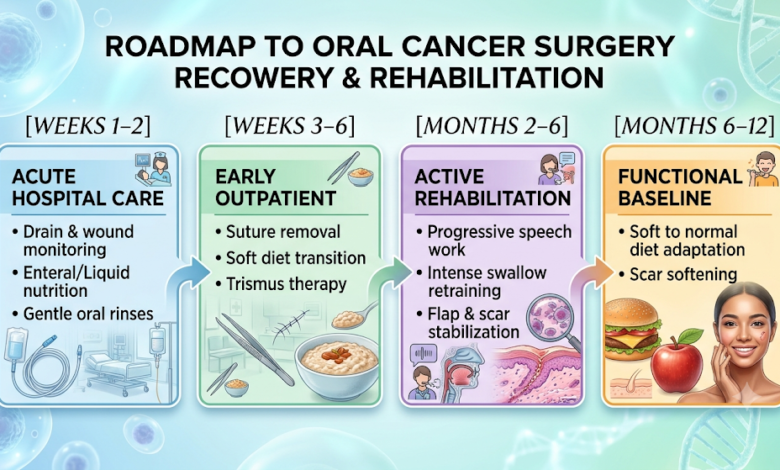
1. Acute In-Hospital Phase (Days 1 to 14)
The first step happens while doctors watch to keep you safe. They check the cut areas, help with pain, and make sure you get enough food.
Surgical Wound Care and Airway Management
- Flap Monitoring: If physicians use the free flap reconstruction technique to reconstruct inside the mouth using tissues, then nurses monitor the color, texture, and temperature of these tissues every 1-2 hours.
- Drainage Care: Drains under the skin of the neck flap allow drainage of excess fluid. These drains will be removed once there is less than 20-30 mL drainage per day.
- Mouth Rinse Protocol: Rinsing the mouth with saltwater and non-alcohol chlorhexidine solution prevents bacteria from accumulating around sutures.
Post-Surgery Nutritional Stages
Most people move through several diet stages based on where the surgery was done and how complex the repair was.
| Stage | Expected Timeline | Recommended Foods / Fluids | Clinical Goal |
| Stage 1: Enteral / Liquid | Days 1–5 | Nasogastric (NG) tube feeds, clear broth, water | Protect internal oral suture lines while providing full caloric intake |
| Stage 2: Full Liquids | Days 6–14 | Blended high-protein soups, yogurt, smooth dal water, shakes | Introduce oral swallow reflex under speech-language pathologist supervision |
| Stage 3: Pureed & Soft | Weeks 2–6 | Khichdi, mashed potatoes, soft paneer, scrambled eggs, pureed vegetables | Build bolus control without requiring heavy mastication (chewing) |
| Stage 4: Mechanical Soft | Weeks 6–12 | Tender fish, soft-cooked grains, well-steamed vegetables | Train tongue propulsion and restored jaw articulation |
2. Restoring Jaw Mobility and Preventing Trismus
Trismus, or trouble opening the mouth, happens when scar tissue pulls tight. It can also occur if radiation treatment makes the muscles in the jaw hard and stiff. This mainly affects the masseter and pterygoid muscles.
Diagnostic Threshold
A regular adult can open his or her mouth about 35 mm to 50 mm wide. This is about as wide as fitting three fingers between the teeth. If you can open your mouth less than 35 mm, then you may have trismus. A person with trismus needs to start exercises right away.
Prevention and Physical Therapy
- Passive Jaw Stretchers: Mechanical jaw tools gently help to stretch the jaw joint during 15-minute sets on different times in the day.
- Stacked Tongue Depressors: A simple and low-cost option is to put several wooden tongue blades between the back teeth, putting in one more blade each day as the jaw gets looser.
- Active Range-of-Motion Drills: Do these moves every day—open your mouth up and down and move your jaw from side to side. This will help keep your TMJ joint moving well.
3. Emotional and Psychological Rehabilitation
Modifications of the face, speech, and eating may influence one’s self-perception. Modifications of such a nature also affect an individual’s mood and happiness.
- Body Image Changes Management: Collaboration with maxillofacial prosthodontists and reconstructive teams enables to achieve a positive result concerning the improvement of the face appearance and tooth alignment through time.
- Psychological Support Services: Seeking assistance from psycho-oncology counseling, peer support groups, and family therapy will help to cope with fears after the surgery and become less depressed.
- Supportive Care Services Integration: In modern oncology, there is the practice of providing pain management services, nutrition planning, and structural recommendations for patients’ recovery.
Looking for complete cancer care with special oral cancer treatment in Mumbai helps people feel better in their bodies, get back to normal with what they say or do, and enjoy life for a long time.
Rebuilding Function and Life After Surgery
The recovery process after undergoing treatment for mouth cancer will take a while. You will need adequate time for healing and adjustments to the different methods that can enable you to perform certain tasks. In the early stages, while you are still in the hospital, most of the care provided will be directed towards wound care and ensuring that you get the appropriate nutrition. Once discharged from the hospital, there will be various things that you should concentrate on, such as speech exercises, swallowing exercises, jaw exercises, and counseling. It will be important for you to remain in contact with the different health professionals because they will ensure that you acquire the necessary skills.