

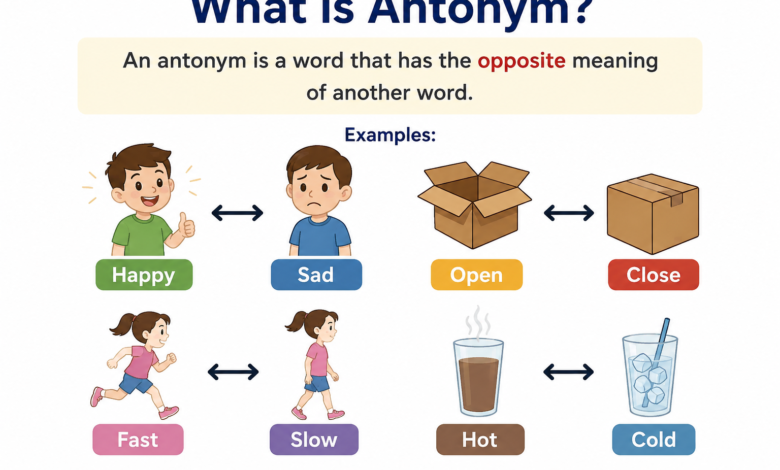
Understanding the meaning of words is an important part of learning English. Some words have meanings that are completely different from each other. These words are called antonyms. They help us compare ideas, describe differences, and make our writing more clear and interesting.
If you have ever wondered what is antonym, the simple answer is this: an antonym is a word that has an opposite or nearly opposite meaning to another word. For example, hot is an antonym of cold, while happy is an antonym of sad.
Antonyms appear in everyday conversations, school lessons, books, news reports, and professional writing. Learning them can improve vocabulary and make it easier to express thoughts accurately.
What Is Antonym?
An antonym is a word that expresses an opposite or contrasting meaning to another word.
For example:
| Word | Antonym |
|---|---|
| Big | Small |
| Happy | Sad |
| Fast | Slow |
| Easy | Difficult |
| Early | Late |
| Strong | Weak |
| Open | Closed |
| Hot | Cold |
| Rich | Poor |
| Light | Dark |
The relationship between two opposite words is known as antonymy. The words do not always have to be exact opposites. In some cases, they simply show a strong contrast.
For example, beautiful and ugly express opposite ideas. Similarly, begin and end describe opposite points in an activity or process.
Why Are Antonyms Important?
Antonyms are useful because they allow people to explain differences without using long descriptions.
Imagine you want to describe a road. You could say, “The road does not have a high speed.” However, saying “The road is slow” or describing it as a “low-speed road” may communicate the idea more directly, depending on the context.
Antonyms also help learners build vocabulary. When you learn one new word, learning its opposite can help you remember both words.
Some important benefits include:
- They improve vocabulary.
- They make communication clearer.
- They help explain differences.
- They make writing more varied.
- They support reading comprehension.
- They help students understand word relationships.
- They make descriptions more precise.
Common Examples of Antonyms
Antonyms are found in almost every part of English vocabulary. Here are some common examples.
Adjective Antonyms
Adjectives describe people, places, objects, or ideas. Many adjectives have clear opposites.
Examples include:
- Tall — Short
- Young — Old
- Clean — Dirty
- Strong — Weak
- Kind — Cruel
- Bright — Dark
- Full — Empty
- Wide — Narrow
- Cheap — Expensive
- Quiet — Noisy
These pairs help describe differences between people and things.
For example:
The box is full.
The bottle is empty.
The words full and empty have opposite meanings.
Verb Antonyms
Verbs describe actions or states. Many verbs also have opposite meanings.
Examples include:
- Come — Go
- Give — Take
- Buy — Sell
- Push — Pull
- Laugh — Cry
- Accept — Reject
- Remember — Forget
- Arrive — Leave
- Start — Stop
- Build — Destroy
Consider this example:
She arrived early, but her friend left late.
The verbs arrive and leave describe contrasting actions.
Noun Antonyms
Nouns can also have opposite or contrasting meanings.
Examples include:
- Love — Hate
- Success — Failure
- Friend — Enemy
- Day — Night
- Life — Death
- Beginning — Ending
- Peace — War
- Advantage — Disadvantage
These pairs often describe opposing conditions, ideas, or relationships.
Adverb Antonyms
Adverbs can describe how, when, or where something happens. Some also have opposites.
Examples include:
- Quickly — Slowly
- Always — Never
- Early — Late
- Here — There
- Together — Apart
- Often — Rarely
- Inside — Outside
For example:
He walked quickly.
He walked slowly.
The words quickly and slowly show opposite ways of performing an action.
Types of Antonyms
Not every pair of antonyms works in exactly the same way. Linguists commonly identify several types of antonym relationships.
Gradable Antonyms
Gradable antonyms describe opposite ends of a scale. There can be different levels between the two words.
Examples include:
- Hot — Cold
- Big — Small
- Fast — Slow
- Rich — Poor
- Happy — Sad
- Young — Old
For example, something can be warm without being hot or cold. A person can also be somewhat happy rather than completely happy or sad.
This makes gradable antonyms different from absolute opposites.
Complementary Antonyms
Complementary antonyms represent two conditions where one normally excludes the other.
Examples include:
- Alive — Dead
- True — False
- Present — Absent
- Legal — Illegal
- On — Off
For example, something that is switched on is not switched off at the same time in the ordinary sense.
These words usually present a clear contrast.
Relational Antonyms
Relational antonyms describe opposite roles or relationships. One word often makes sense in relation to the other.
Examples include:
- Buy — Sell
- Give — Receive
- Teacher — Student
- Parent — Child
- Employer — Employee
- Borrow — Lend
For example, when someone buys something, another person usually sells it. The two words describe different sides of the same relationship.
Antonyms and Synonyms
Antonyms and synonyms are closely related vocabulary concepts, but they work in opposite ways.
A synonym is a word with the same or a similar meaning.
An antonym is a word with an opposite or contrasting meaning.
For example:
| Word | Synonym | Antonym |
|---|---|---|
| Happy | Joyful | Sad |
| Large | Big | Small |
| Begin | Start | End |
| Fast | Quick | Slow |
| Easy | Simple | Difficult |
| Brave | Courageous | Cowardly |
| Quiet | Silent | Noisy |
Understanding both concepts can make vocabulary learning much easier.
How to Identify an Antonym
Finding an antonym is usually simple when you understand the meaning of the original word.
Start by asking: What idea is the opposite of this word?
For example, if the word is dark, think about its opposite. The answer is light.
If the word is early, the opposite is late.
You can use these steps:
- Read the word carefully.
- Understand its meaning.
- Think about the opposite idea.
- Check whether the opposite fits the sentence.
- Consider the context before choosing an answer.
Context matters because some words can have different meanings.
For example, hard can mean physically firm, difficult, or requiring effort. Its opposite could be soft in one sentence and easy in another.
Antonyms in Sentences
Learning antonyms becomes easier when you see them in complete sentences.
The old house looks different from the new house.
Here, old and new create a contrast.
The water was hot in the morning but cold at night.
Here, hot and cold are opposites.
Please open the door and close the window.
The verbs open and close express contrasting actions.
He arrived early, while his brother arrived late.
The words early and late show opposite times.
The exam was difficult for some students but easy for others.
The words difficult and easy express contrasting levels of challenge.
Antonyms in Everyday English
People use antonyms every day, often without thinking about them.
Common expressions include:
- Young and old
- Black and white
- Day and night
- Good and bad
- Right and wrong
- Up and down
- In and out
- Before and after
- Near and far
- High and low
Antonyms are especially useful when comparing two things.
For example:
The first room was large, but the second room was small.
The first test was easy, while the second test was difficult.
This type of contrast makes communication direct and easy to understand.
Antonyms in Writing
Good writing often uses contrast to make ideas stronger. Antonyms can help writers show changes, differences, and opposing opinions.
For example:
The journey started with excitement but ended in disappointment.
The contrast between started and ended, as well as excitement and disappointment, gives the sentence more impact.
Antonyms can also reduce repetition. Instead of repeatedly explaining differences, a writer can use precise opposite words.
This is useful in:
- Descriptive writing
- Essays
- Stories
- News writing
- Educational content
- Business communication
- Everyday messages
Common Antonym Mistakes
Although antonyms seem simple, learners sometimes make mistakes.
Assuming Every Word Has One Exact Opposite
Not every word has a single perfect antonym.
For example, the opposite of light could be dark when discussing brightness. But light can also mean something that is not heavy, in which case its opposite is heavy.
Ignoring Context
Context determines the correct opposite.
Consider the word cold. Its opposite may be hot when discussing temperature. But in some contexts, the contrast could be warm.
Always consider how the word is being used.
Confusing Antonyms With Unrelated Words
Two words are not antonyms simply because they are different.
For example, apple and orange are different words, but they are not antonyms. They belong to the same broad category of fruit, but neither represents the opposite of the other.
How to Improve Your Vocabulary With Antonyms
A simple way to improve vocabulary is to study words in pairs.
Instead of learning only increase, learn:
Increase — Decrease
Instead of learning only accept, learn:
Accept — Reject
Instead of learning only strong, learn:
Strong — Weak
You can create a personal vocabulary list and review a few pairs each day.
Another useful method is to write sentences using both words. This helps you understand how the words work in real situations.
For example:
The company increased production last year but decreased it this year.
This approach helps you learn meaning, grammar, and usage together.
A Useful List of Common Antonyms
| Word | Opposite |
|---|---|
| Accept | Reject |
| Add | Subtract |
| Arrive | Depart |
| Beautiful | Ugly |
| Begin | Finish |
| Best | Worst |
| Borrow | Lend |
| Brave | Cowardly |
| Careful | Careless |
| Create | Destroy |
| Deep | Shallow |
| Difficult | Easy |
| Dry | Wet |
| Empty | Full |
| Enter | Exit |
| Expand | Contract |
| Give | Receive |
| Happy | Sad |
| Healthy | Unhealthy |
| Include | Exclude |
| Increase | Decrease |
| Inside | Outside |
| Kind | Cruel |
| Laugh | Cry |
| Maximum | Minimum |
| Natural | Artificial |
| Near | Far |
| Noisy | Quiet |
| Open | Closed |
| Public | Private |
| Remember | Forget |
| Safe | Dangerous |
| Simple | Complicated |
| Start | Stop |
| Strong | Weak |
| Success | Failure |
| True | False |
| Victory | Defeat |
| Visible | Invisible |
| Young | Old |
Frequently Asked Questions
What is an antonym in simple words?
An antonym is a word that has an opposite or contrasting meaning to another word. For example, big and small are antonyms.
What is the opposite of an antonym?
The opposite concept is a synonym. A synonym has the same or a similar meaning, while an antonym expresses an opposite or contrasting meaning.
Are all antonyms exact opposites?
No. Some antonyms show different points on a scale. For example, hot and cold can have several levels between them, such as warm or cool.
Can one word have several antonyms?
Yes. A word can have different opposites depending on its meaning and context. Light, for example, can be opposite to dark when referring to brightness or heavy when referring to weight.
Why should students learn antonyms?
Antonyms help students expand vocabulary, understand reading material, compare ideas, and communicate more clearly.
Final Thoughts
Knowing what is antonym gives English learners a simple but powerful way to expand their vocabulary. Antonyms show opposite or contrasting meanings, and they appear in everyday speech, writing, education, and professional communication.
Words such as hot and cold, big and small, happy and sad, and early and late are easy examples. However, antonym relationships can be more complex when context changes the meaning of a word.
The best way to learn antonyms is to study them in pairs, use them in sentences, and pay attention to context. With regular practice, these word relationships can improve vocabulary and make English communication clearer, more precise, and more natural.